
This article on compounded vs brand-name GLP-1s is for educational purposes only and is not medical advice. A licensed clinician prepares compounded medications under a valid, patient-specific prescription, following applicable federal and state pharmacy regulations, which can change over time and vary by circumstance. Your provider can speak to current availability and whether compounded medication is appropriate for you. Treatment is not guaranteed.
What You Should Know
The Word That Makes People Pause
If you’ve been researching GLP-1 weight care, you’ve probably run into the word “compounded.” Maybe it gave you a flicker of uncertainty. Does compounded mean knockoff? Is it less safe? Is it even legal?
These are fair questions. The honest answer needs a little context, not a soundbite. This article explains what “compounded” actually means, how it differs from brand-name medication, and what to look for — and ask about — before you start treatment with any provider offering it.
Why This Matters
Misinformation runs in both directions on the compounded vs brand-name GLP-1s question. Some sources treat “compounded” as automatically suspicious or inferior. Others treat it as a simple, interchangeable substitute with no meaningful differences at all. Neither framing is accurate.
Understanding what compounding actually involves, and what safeguards should be in place, helps you evaluate a provider or pharmacy with real information instead of assumptions in either direction.
What “Compounded” Means
Compounding means a licensed pharmacy prepares a customized medication for an individual patient, based on a valid prescription from a licensed clinician. It’s a long-established, legal part of pharmacy practice. It isn’t unique to GLP-1 medications, and it isn’t inherently a workaround or shortcut.
State boards of pharmacy oversee compounding pharmacies. Federal requirements apply too. Pharmacies generally can compound a medication only under specific, defined circumstances tied to an individual patient’s documented clinical needs.
Active Ingredients
Compounded semaglutide and compounded tirzepatide use the same active pharmaceutical ingredients as brand-name products like Ozempic®, Wegovy®, Mounjaro®, and Zepbound®. The chemical compound doing the work in your body is the same molecule. What differs is how a pharmacy prepares, packages, and regulates the medication — not the underlying active ingredient itself.
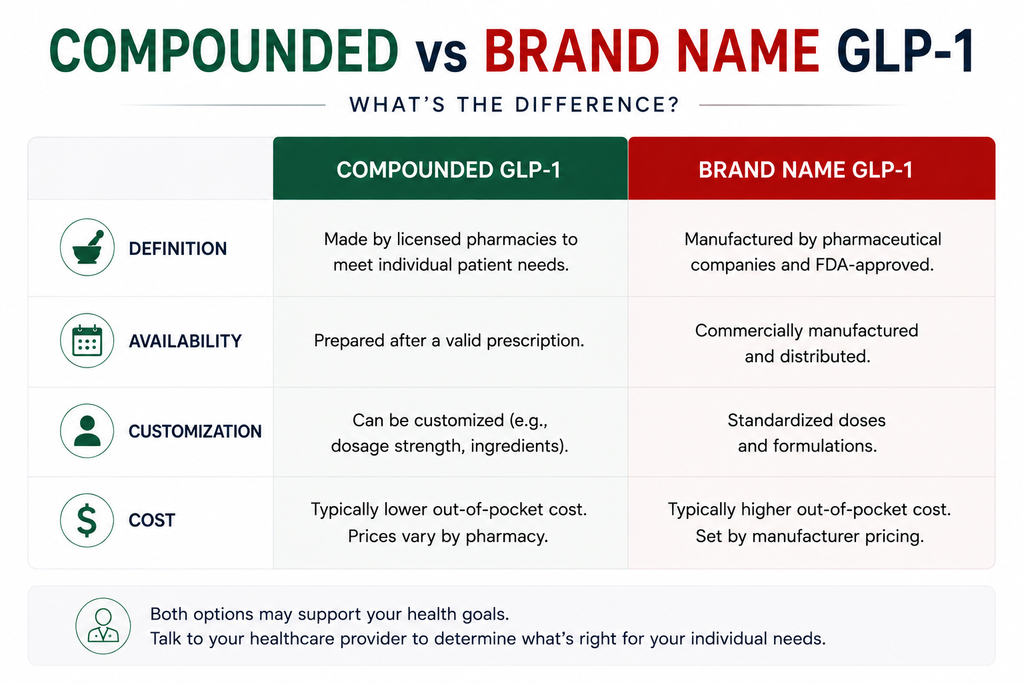
How Compounded vs Brand-Name GLP-1s Differ
FDA Status
This is the most important distinction to understand about compounded vs brand-name GLP-1s. Brand-name GLP-1 products go through the FDA’s full drug approval process. That process evaluates a specific, finished, manufactured product for safety and effectiveness, including its exact formulation, manufacturing process, and packaging.
Compounded medications work differently. The FDA doesn’t individually approve them as finished products, even when a pharmacy builds them from an FDA-approved active ingredient. Instead, a separate pharmacy-compounding framework regulates them. That framework focuses oversight on the pharmacy’s practices, sourcing, and quality standards, rather than on FDA approval of the specific compounded product.
This isn’t a detail to gloss over, and it isn’t a reason to assume compounded medication is unsafe. It’s simply a different regulatory pathway. We believe it’s worth disclosing plainly, rather than blurring the line between “compounded” and “FDA-approved.”
Compounding, as a category, has existed in pharmacy practice for a very long time. Pharmacies use it for medications ranging from customized dosages for children to allergen-free formulations for patients with specific sensitivities. GLP-1 compounding sits within that same, long-standing framework. It isn’t a novel workaround invented for this category of medication.
Regulation defines the specific circumstances under which a pharmacy can compound a given medication. Those conditions can vary depending on the medication, the pharmacy’s licensing type, and the patient’s individual clinical situation. This is exactly why an individualized clinician evaluation matters: compounding isn’t meant to work as a blanket, one-size-fits-all substitute for an FDA-approved product. It’s an option that fits a documented, patient-specific need.
The Role of Licensed Compounding Pharmacies
Not all compounding is created equal, and this is where sourcing and oversight matter enormously.
Legitimate compounding happens at licensed pharmacies. These pharmacies fall under state board of pharmacy oversight, follow defined quality and sterility standards, and prepare medications only against valid, patient-specific prescriptions — not bulk production sold without an individualized prescribing relationship.
Detailed regulatory requirements govern which pharmacies can compound which medications, and under what circumstances, and these requirements can evolve over time. That’s part of why working with a pharmacy that stays current matters as much as the medication itself.
Broadly speaking, compounding pharmacies fall into a couple of different regulatory categories, each with its own oversight structure. Some prepare medications for individual patients against specific prescriptions. Others operate at a larger scale under a different set of federal standards. Ask your provider or pharmacy directly which category applies, and what that means for sourcing and quality assurance, rather than assuming all compounding operations work identically.
Safety, Sourcing & Transparency: What to Verify
Before starting any compounded medication, ask specific questions about how it’s sourced and regulated. A legitimate provider or pharmacy should be able to answer clearly:
- Is a licensed pharmacy compounding the medication, and can you confirm its licensing status?
- Does the pharmacy prepare the medication against a valid, patient-specific prescription rather than in bulk?
- Which quality and sterility standards does the pharmacy follow?
- How does the pharmacy stay current with evolving regulatory requirements for this medication?
- Will the provider clearly disclose the medication’s FDA status, rather than implying it’s the same as the FDA-approved brand?
- Does ongoing provider support come with the medication, or is this a one-time transaction?
Be cautious of a provider or pharmacy unwilling to answer these questions clearly, or one that seems to blur the distinction between “compounded” and “the same as the FDA-approved brand.”
Common Myths About Compounded vs Brand-Name GLP-1s
Myth: “Compounded means fake or counterfeit.” Compounded medications use the same active pharmaceutical ingredients as their brand-name counterparts. A licensed pharmacy prepares them under a valid prescription. That’s meaningfully different from a counterfeit or unregulated product — but it does require sourcing from a legitimate, licensed pharmacy to be true.
Myth: “If it’s compounded, it must be unsafe.” Compounding pharmacies operate under real regulatory oversight, including state board of pharmacy requirements and quality standards. Safety depends heavily on choosing a pharmacy and provider who take that oversight seriously. Compounding as a category isn’t itself a safety red flag.
Myth: “Compounded and brand-name are functionally identical in every way.” They share the same active ingredient, but they differ in regulatory pathway, and potentially in formulation details like inactive ingredients or concentration. This is exactly why transparency about which one you’re receiving matters.
Myth: “Lower cost automatically means lower quality.” Pricing differences between compounded and brand-name medications reflect a range of factors, including manufacturing scale, marketing costs, and distribution — not necessarily a shortcut on safety. That said, price alone isn’t a reliable indicator of legitimacy either; sourcing and oversight are what actually matter.
Myth: “Anyone can legally compound GLP-1 medications.” Defined, evolving regulatory requirements govern compounding of these specific medications. Not just any pharmacy can do it without meeting specific conditions. This is exactly why verifying a pharmacy’s licensing and practices matters, rather than assuming all providers offering compounded GLP-1s operate the same way.
A Note From Our Clinical Team
Transparency about compounded medication isn’t a footnote for us. Our clinical and pharmacy partners treat it as a baseline expectation.
Patients deserve to understand exactly what they’re receiving, how it’s regulated, and why a provider believes it’s an appropriate option for their specific situation. If you ever have questions about your medication’s sourcing or regulatory status, raise them directly with your care team — that’s a completely reasonable thing to ask.
Frequently Asked Questions
The FDA approves the active ingredient, semaglutide, when it’s used in specific FDA-approved brand-name products. The FDA doesn’t independently approve the compounded version as a finished product — a separate pharmacy-compounding framework regulates it instead. This distinction is worth understanding clearly before starting treatment.
Safety depends significantly on sourcing. A compounded medication that a licensed pharmacy prepares under a valid patient-specific prescription and appropriate quality standards is a different situation than an unregulated product from an unverified source. Discuss any safety questions directly with your prescribing clinician.
Pricing differences can reflect manufacturing scale, marketing costs, and distribution models, among other factors. Cost alone doesn’t indicate quality or legitimacy in either direction — sourcing and oversight are what matter most.
Look for a licensed compounding pharmacy, a real clinician evaluation (not a generic intake with no meaningful review), transparency about the medication’s regulatory status, and ongoing provider support rather than a one-time transaction. Regulatory requirements in this space are specific and can evolve, so a provider who stays current with them, rather than treating compounding as a simple, static option, is a meaningful signal of legitimacy.
The Takeaway
“Compounded” isn’t a red flag on its own, and it isn’t a guarantee either. It’s a distinct regulatory category that depends heavily on sourcing, oversight, and transparency to be a responsible option.
Understanding the real difference between compounded vs brand-name GLP-1s — same active ingredient, different regulatory pathway — gives you the context to ask better questions and evaluate any provider more confidently, rather than relying on assumptions in either direction. Because this is an area where regulations can evolve, the most reliable source of current information is always a direct conversation with your licensed provider, not a single article.
Have questions about how your medication is sourced and regulated? Our clinical team is transparent about it every step of the way. See how Vivo Now works → https://vivonow.com/