
This article is for educational purposes only and is not medical advice. Vivo Now offers compounded semaglutide and tirzepatide, prescribed only after a licensed clinician evaluation. Treatment is not guaranteed, and individual results vary.
How GLP-1 Medications Work for Weight Loss: A Beginner’s Guide
You’ve tried the diet-and-exercise formula. You did everything “right.” So why did it feel so hard?
Maybe you’ve white-knuckled your way through a calorie deficit — tracking every bite, forcing yourself through workouts, and still feeling hungry and depleted by 3 p.m. If so, you already know the frustrating truth: for a lot of people, weight loss isn’t a willpower problem. It’s a biology problem.
Your body has an elaborate hormonal system that regulates hunger, fullness, and energy storage. For many people, that system works against sustained weight loss, no matter how disciplined they are.
They’re not a shortcut. They’re a tool that works directly with that hormonal system, rather than against it. This guide breaks down, in plain language, what GLP-1 medications actually are, how they support weight care, and what it means to find out if you’re a candidate.
What GLP-1 Is
GLP-1 stands for glucagon-like peptide-1. It’s a hormone your body already produces naturally in your gut after you eat. Its job is to help regulate blood sugar and send signals of fullness to your brain.
GLP-1 medications work by mimicking this naturally occurring hormone. They produce a stronger, more sustained effect than your body typically generates on its own.
It’s worth naming clearly upfront: the active ingredients in these medications — semaglutide and tirzepatide — are the same ones you’ll find in brand-name products like Wegovy®, Ozempic®, and Mounjaro®. Vivo Now dispenses compounded versions of these medications; a licensed compounding pharmacy prepares them. Compounded medications don’t carry FDA approval as standalone products, even when they use an FDA-approved active ingredient. That’s a distinction worth understanding, and one we’re always transparent about.
How GLP-1 Supports Weight Care
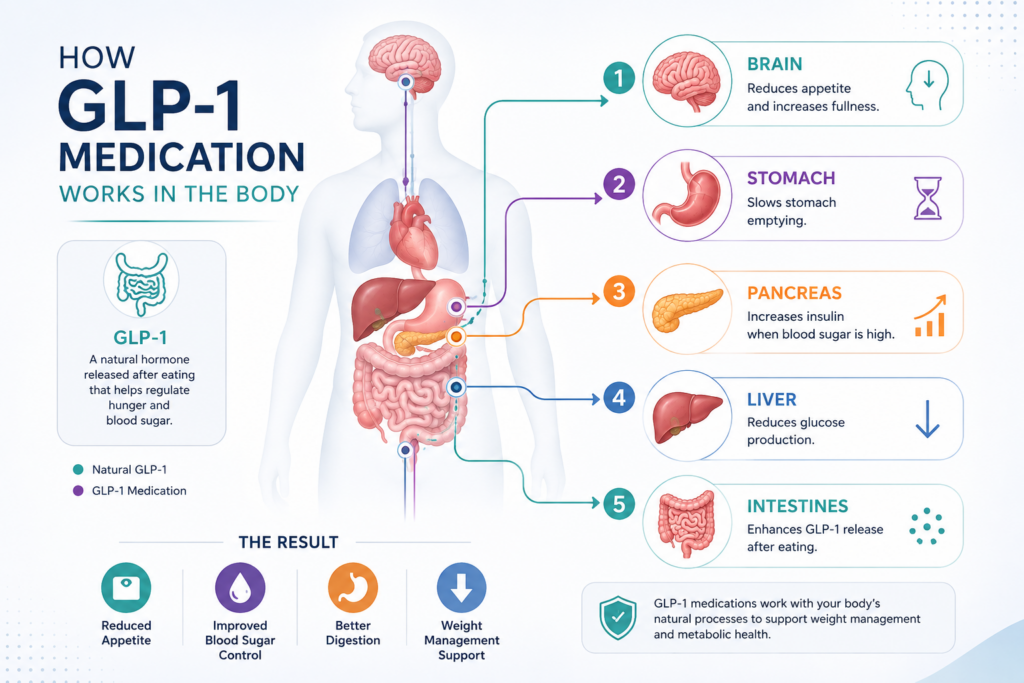
GLP-1 medications don’t target just one mechanism. Instead, they work with several parts of your body’s natural appetite-and-metabolism system at once. That’s part of why they represent a meaningfully different approach than older weight-loss medications, which typically relied on a single pathway — like stimulating the central nervous system or blocking fat absorption.
The 4 Key Mechanisms
Appetite and satiety. GLP-1 medications act on the areas of the brain that regulate hunger and fullness. In practical terms, this often means feeling satisfied with smaller portions. It also means experiencing less of the persistent, intrusive hunger that makes calorie reduction so hard to sustain through willpower alone.
Digestion. These medications slow gastric emptying — the rate at which food moves from your stomach into your small intestine. Food stays in your stomach longer, which extends the feeling of fullness after a meal and reduces the urge to eat again soon after.
Blood sugar regulation. GLP-1 medications support healthier blood sugar regulation. They help your body release insulin in response to elevated glucose, while also suppressing glucagon, a hormone that raises blood sugar. This glucose-responsive mechanism is part of why these medications carry a relatively low risk of dangerously low blood sugar in people without diabetes.
Supporting the use of stored energy. As appetite and intake decrease under medical guidance, the body increasingly draws on stored energy reserves, including fat, to meet its needs. This is a downstream result of the appetite and metabolic effects above — not a separate, independent mechanism.
Why This Combination Matters
Many earlier weight-management approaches worked against a single lever. They’d suppress appetite through a stimulant, or block a portion of dietary fat from absorption, while leaving the rest of the body’s hunger-and-fullness signaling untouched.
GLP-1 medications work differently. Because they engage several parts of the same hormonal system that governs hunger, fullness, and blood sugar, the appetite reduction tends to feel less like forced restriction. Instead, it feels more like the normal, biological experience of already being satisfied. That’s a meaningful distinction for anyone who has tried — and struggled to sustain — a purely willpower-based approach in the past.
None of this means GLP-1 therapy works identically for everyone, or that it removes the role of nutrition and activity altogether. It means people finally get direct help with the biological “wall” that makes sustained calorie reduction so difficult — rather than facing it with willpower alone.
Who It May Be Right For
GLP-1 therapy isn’t automatically appropriate for everyone, and eligibility isn’t something you can self-determine from an article. In general, licensed clinicians consider a person’s health history, current medications, relevant risk factors, and overall goals before determining candidacy.
Certain personal or family medical histories call for careful evaluation before a GLP-1 medication makes sense. That’s exactly why the process starts with a licensed clinician’s review, rather than a self-selected purchase.
What to Expect
Vivo Now doesn’t provide dosing or self-treatment instructions in marketing content, so this section stays high-level. Still, here are a few general things worth knowing as you consider getting started:
- The process starts with a purchase, not an intake. You’ll complete a health history, and a licensed clinician reviews it before making any prescribing decision.
- Appetite changes are often the first thing people notice, generally before more visible changes.
- Adjustment takes time. As your body adapts to the medication, some people experience temporary digestive side effects, which your care team can help you navigate.
- This works best paired with sustainable habits — nourishing food, movement you enjoy, and consistent sleep — not as a standalone fix.
- Provider support continues throughout treatment, not just at the start. Ongoing check-ins are part of the process, not an afterthought.
- Your plan can change over time. As your body responds to treatment, your provider may revisit your plan of care based on how you’re doing. That’s a normal, expected part of an ongoing clinical relationship, not a sign anything has gone wrong.
- Habits still matter, and your care team can help with them too. Protein intake, movement, sleep, and stress management all interact with how your body responds to treatment. Many providers weave this guidance into your ongoing care, rather than treating the medication as the only variable.
Individual results vary, and you’ll only receive treatment if it’s appropriate for you.
Common Myths
Myth: “GLP-1 is the easy way out.” GLP-1 medications work with your biology — helping regulate the same hunger and fullness signals your body already produces — rather than replacing effort altogether. It’s not willpower versus weakness. It’s medically supported weight care, paired with the habits you build alongside it.
Myth: “It’s basically the same as Ozempic or Wegovy, so it must be FDA-approved the same way.” The active ingredients are the same, but compounded medications go through different preparation and don’t carry FDA approval as standalone products. This is a meaningful distinction, and it’s one we disclose plainly rather than glossing over.
Myth: “Once you start, you’ll definitely lose weight fast.” Individual results vary significantly based on health history, adherence, and other factors. No one can guarantee a specific outcome, timeline, or amount of weight loss for any individual.
Myth: “You’ll need this forever, or you’ll immediately regain everything.” What happens after any weight-care approach — GLP-1 included — depends heavily on the individual and the habits built during treatment. It’s not a fixed, one-size-fits-all outcome.
Myth: “It’s a shortcut that skips the real work.” Sustainable weight care still involves nutrition, movement, and consistency. GLP-1 therapy addresses a specific biological barrier — persistent hunger signaling — that often makes that real work far harder to sustain. It doesn’t eliminate the need for it.
Myth: “If a friend or family member had a certain experience, mine will be the same.” Individual biology, health history, and habits all influence how someone responds to treatment. So, one person’s experience — good or bad — doesn’t reliably predict another’s. This is part of why a personalized evaluation matters more than anecdotes.
A Note From Our Clinical Team
One of the most common questions our clinicians hear is some version of “will this actually work for me?” The honest answer: it depends on your individual biology, health history, and how the medication is paired with your daily habits. That’s exactly why a real evaluation matters more than a generic promise. Our providers walk through your history, talk through what to realistically expect, and stay involved throughout treatment — not just at the starting line.
Frequently Asked Questions
GLP-1 medications are prescription treatments that mimic a naturally occurring gut hormone involved in regulating appetite, digestion, and blood sugar. Semaglutide and tirzepatide are among the most widely used active ingredients in this category.
Like any prescription treatment, GLP-1 therapy carries potential risks and isn’t appropriate for everyone. Safety depends on individual health history, so we require a licensed clinician evaluation before considering any prescription.
This varies by individual. Vivo Now doesn’t promote specific timelines or outcome numbers, since results depend on your unique biology and circumstances. Your provider can talk through general expectations during your evaluation and ongoing care.
A licensed clinician determines candidacy based on your health history, current medications, and individual risk factors — not a fixed checklist you can self-assess. The only way to know is to complete an intake and have a provider review it.
The Takeaway
GLP-1 medications represent a genuinely different approach to weight care — one that works with your body’s own appetite and metabolic signaling, rather than relying purely on willpower. Understanding the actual mechanism (appetite regulation, slower digestion, blood sugar support) helps separate the real science from both the hype and the skepticism surrounding this category.
Whether it’s the right fit for you is a question only a licensed clinician can answer, based on your specific history and goals.
Curious if GLP-1 weight care could be right for you? A licensed clinician can help you find out. Check your eligibility → https://vivonow.com/check-eligibility/?goal=weight-loss