
This article on why skin ages faster than it used to is for educational purposes only and is not medical advice. Vivo Now’s Skin & Hair category explores compounds like GHK-Cu and glutathione, prescribed only after a licensed clinician evaluation. Treatment is not guaranteed, and individual results vary.
Why Skin Ages Faster Than It Used To (And What Actually Helps)
Your skincare routine hasn’t changed. Your skin has.
You’re using the same cleanser, the same moisturizer, maybe even the same sunscreen you’ve relied on for years. But somewhere along the way, the results stopped matching the effort. Fine lines show up sooner. Skin takes longer to bounce back after a bad night’s sleep or a stressful week. What used to fade by morning now lingers for days.
This isn’t a sign your routine failed. It’s a sign your skin’s underlying biology has shifted, and understanding what’s actually changing is far more useful than chasing the next trending ingredient.
This article breaks down the real mechanisms behind why skin ages faster, what research says genuinely helps, and where medically-guided options fit in for people who want to go beyond the basics.
Why This Matters Beyond Appearance
Skin aging isn’t purely cosmetic. Why skin ages faster comes down to real changes in tissue structure, hydration, and the skin’s ability to repair itself.
Chasing quick fixes without understanding the underlying biology is exactly how people end up cycling through products that promise a lot and deliver little. Understanding what’s actually driving the changes you’re seeing is what separates a routine that genuinely supports your skin from one that’s just marketing.
Why Skin Ages Faster: What’s Actually Happening
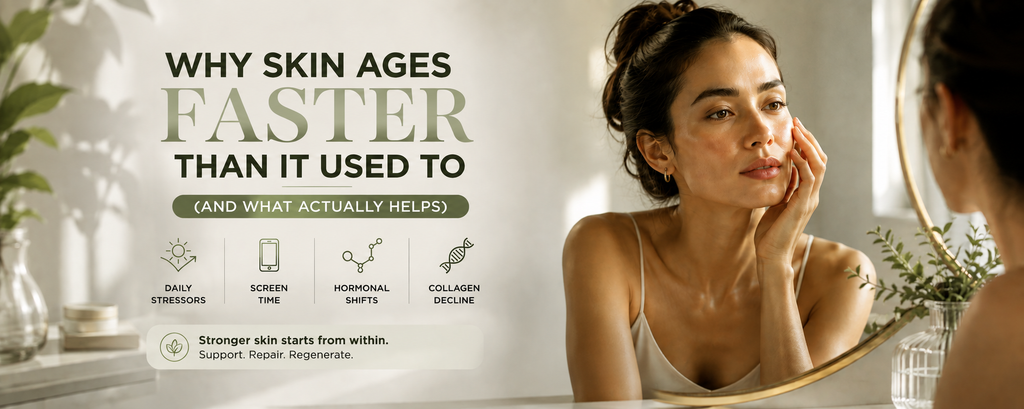
Skin aging comes from a combination of processes happening both from external exposure and from the natural aging process itself.
Collagen Production Slows While Breakdown Speeds Up
Collagen is the structural protein that keeps skin firm and elastic. Research on skin biology describes a specific imbalance behind visible aging: enzymes called matrix metalloproteinases (MMPs) actively break down collagen. At the same time, the signaling pathways that normally trigger new collagen production become less responsive.
The result is a net loss of collagen over time. Skin loses structural support, which shows up as thinning, sagging, and reduced elasticity.
Oxidative Stress Accelerates the Damage
Reactive oxygen species, also known as free radicals, come from normal metabolism and from exposure to UV light and pollution. They damage collagen directly and activate the same pathways that increase collagen-degrading enzymes while suppressing new collagen synthesis.
Dermatology research consistently identifies this as one of the most reliable drivers of skin aging. It’s a big part of why sun exposure and oxidative stress get so much emphasis in skin-health advice.
Sugar Changes How Collagen Behaves
Through a process called glycation, sugar molecules bind to collagen fibers, making them stiffer and less functional. Glycated collagen resists normal breakdown, but your body also can’t replace it with new, flexible collagen. Over time, skin ends up with more rigid, less resilient structural support.
UV Exposure Compounds Everything
UV radiation doesn’t just cause sunburn. It directly increases the enzymes that degrade collagen while suppressing new collagen production, and it generates additional oxidative stress on top of what’s already happening from normal aging.
Research consistently identifies UV exposure as one of the single largest accelerants of visible skin aging, separate from the aging process itself.
Cellular Aging Plays a Role Too
As skin cells age, some enter a state called senescence, similar to the process seen elsewhere in the body. These cells stop functioning normally but don’t clear out, and they contribute to chronic low-grade inflammation in the surrounding tissue. That inflammatory backdrop further stresses the skin’s ability to repair and regenerate itself.
Hormonal and Structural Changes Add Another Layer
Beyond collagen and oxidative stress, structural proteins that keep elastic fibers organized decline with age. Those fibers normally help skin snap back into place.
Hormonal shifts also influence skin thickness, hydration, and repair capacity. That’s part of why skin-aging patterns can shift noticeably during certain life stages.
Put together, the picture is clear. Visible skin aging isn’t one single process — it’s the layered result of oxidative stress, collagen imbalance, glycation, UV damage, and cellular changes compounding over years. That’s exactly why single-ingredient “miracle” products rarely deliver on their promises.
What Actually Helps
The research consistently points toward a few categories of intervention with real evidence behind them.
- Daily sun protection is the single highest-leverage habit. UV exposure is one of the most consistently identified accelerants of collagen breakdown, so consistent SPF use has strong, repeated evidence behind it — arguably more impactful than any product applied after sun damage occurs.
- Get antioxidant support, from food and topically. Oxidative stress is such a central driver that diets rich in antioxidants (colorful produce, particularly foods high in carotenoids) and topical antioxidant ingredients both have research support for helping counter free-radical damage.
- Limit added sugar and highly processed foods. Glycation stiffens collagen through excess sugar binding to it, so diet quality has a more direct connection to skin structure than most people realize.
- Prioritize sleep. Skin repair and collagen synthesis both increase during deep sleep. Chronic sleep restriction limits your skin’s ability to keep up with daily oxidative and environmental stress.
- Don’t smoke, and limit alcohol. Both accelerate oxidative stress and collagen breakdown through well-documented mechanisms, independent of any topical routine.
- Be realistic about what topical products can do. Topical treatments can support the skin barrier and provide some antioxidant benefit, but they can’t fully reverse structural collagen loss on their own. This is part of why layered approaches — protection, nutrition, sleep, and sometimes medical guidance — tend to outperform any single product.
Common Mistakes and Myths
Myth: “Expensive products always work better.” Price doesn’t reliably predict effectiveness. What matters more is whether a product’s active ingredients are backed by research and used at effective concentrations — something worth researching or asking a professional about, rather than assuming from packaging or price point.
Mistake: Skipping sunscreen on cloudy days or indoors. UV exposure through windows and on overcast days still contributes to cumulative collagen damage over time. The research supports daily use, not just “sunny day” use.
Myth: “Skin aging is purely genetic — there’s nothing you can do.” Genetics do influence skin aging, but a substantial share of visible aging ties back to modifiable factors: UV exposure, oxidative stress, diet, sleep, and smoking. This is a case where lifestyle genuinely moves the needle.
Mistake: Layering too many active ingredients at once. More isn’t always better. Combining multiple strong actives — retinoids, acids, high-concentration vitamin C — without guidance can irritate skin and actually impair the barrier function that supports healthy aging.
Myth: “Anti-aging supplements or peptides alone can replace sun protection and lifestyle basics.” No ingredient, taken or applied on its own, outperforms consistent sun protection and the foundational habits described above. View anything promising to replace those basics with skepticism.
A Note From Our Clinical Team on Why Skin Ages Faster
Skin concerns are rarely about one single factor, and our clinical team’s approach reflects that. We start with the fundamentals — sun protection, nutrition, sleep — before discussing any additional support.
Some patients, once that foundation is solid, get curious about what current research is exploring beyond the basics. That’s a conversation best had directly with a provider who can evaluate your skin health and history individually.
Where Modern Support Fits In
Sun protection, antioxidant-rich nutrition, and sleep remain the foundation for skin health. For most people, consistent attention to these basics accounts for the majority of what’s achievable.
But some people have already built that foundation and remain curious about what else is being studied. For them, there’s growing interest in clinician-guided support that goes beyond topical products. Vivo Now’s Skin & Hair category explores compounds like GHK-Cu (a copper peptide) and glutathione, studied for their potential roles in skin and antioxidant health, always under a licensed clinician’s guidance. Any exploration starts with a provider evaluation, not a purchase.
Frequently Asked Questions
A combination of genetics, cumulative UV exposure, oxidative stress, diet, sleep quality, and habits like smoking all influence the rate of visible skin aging. That’s why two people the same age can show very different signs of aging.
Yes. UV exposure is one of the most consistently identified drivers of collagen breakdown in dermatology research, which makes consistent daily sun protection one of the highest-evidence interventions available.
Yes. Excess sugar contributes to glycation, which stiffens collagen, while antioxidant-rich foods help counter the oxidative stress that drives collagen breakdown. Both are well-supported connections between diet and skin structure.
Topical products can support the skin barrier and provide antioxidant benefits, but they generally can’t fully reverse structural collagen loss on their own. A layered approach — protection, nutrition, sleep, and in some cases medical guidance — tends to work better than relying on any single product.
Research on GHK-Cu and skin health is ongoing, and it’s not FDA-approved as a treatment. Any exploration of it should happen under the guidance of a licensed clinician who can evaluate whether it’s appropriate for you.
The Takeaway on Why Skin Ages Faster
Skin aging faster than it used to isn’t a mystery, and it isn’t purely bad luck. It’s the layered result of oxidative stress, collagen breakdown, UV exposure, glycation, and cellular changes compounding over time.
The research consistently points to sun protection, antioxidant-rich nutrition, and sleep as the highest-leverage places to start. For some people, that foundation opens the door to exploring additional, medically-guided support with a licensed provider.
Curious whether clinician-guided skin support could fit into your routine? A licensed provider can help you find out. Explore Skin & Hair → https://vivonow.com/check-eligibility/?goal=look-younger